
Libraries are essential to education, research, and the sharing of knowledge.
Whether it's a school library, college library, public library, or independent reading facility, effective management plays an important role in delivering a good experience to readers.
However, many library operators still depend on manual registers, spreadsheets, and paper-based records for everyday activities.
As the number of books and members increases, these methods can become difficult to maintain.
This raises an important question:
Is traditional library management sufficient for the needs of modern libraries?
Let's explore how digital library management can help.
1. Understanding Manual Library Management
Manual library management involves maintaining records using physical registers, files, and sometimes spreadsheets.
Common activities include:
- Recording new books and catalog information.
- Maintaining membership registers.
- Recording book issues and returns.
- Tracking due dates.
- Updating book availability.
- Preparing administrative reports.
Although these methods may be familiar and inexpensive initially, they can create operational difficulties as the library grows.
2. Challenges of Traditional Library Management
Time-Consuming Recordkeeping
Every book issue, return, or membership update may require a manual entry.
Over time, repetitive administrative work can consume valuable staff hours.
Difficulty Finding Information
Locating the details of a particular book or member can become complicated when records are distributed across multiple registers.
Risk of Inconsistent Records
Manual processes may introduce duplicate entries, missing information, or inconsistent updates.
Limited Operational Visibility
Without consolidated reporting, understanding book circulation, overdue items, and membership activity may require additional effort.
Growing Administrative Workload
As collections and memberships expand, the volume of information increases.
Processes that worked for a small library may become less efficient at a larger scale.
3. What Is Digital Library Management?
Digital library management involves using software to organize and support library operations.
A typical library management system may include:
- Book catalog management.
- Membership records.
- Book issuing and returning.
- Due-date tracking.
- Searchable records.
- Administrative reporting.
Instead of relying on disconnected registers, authorized library staff can work with information maintained in a structured system.
The specific capabilities vary between products.
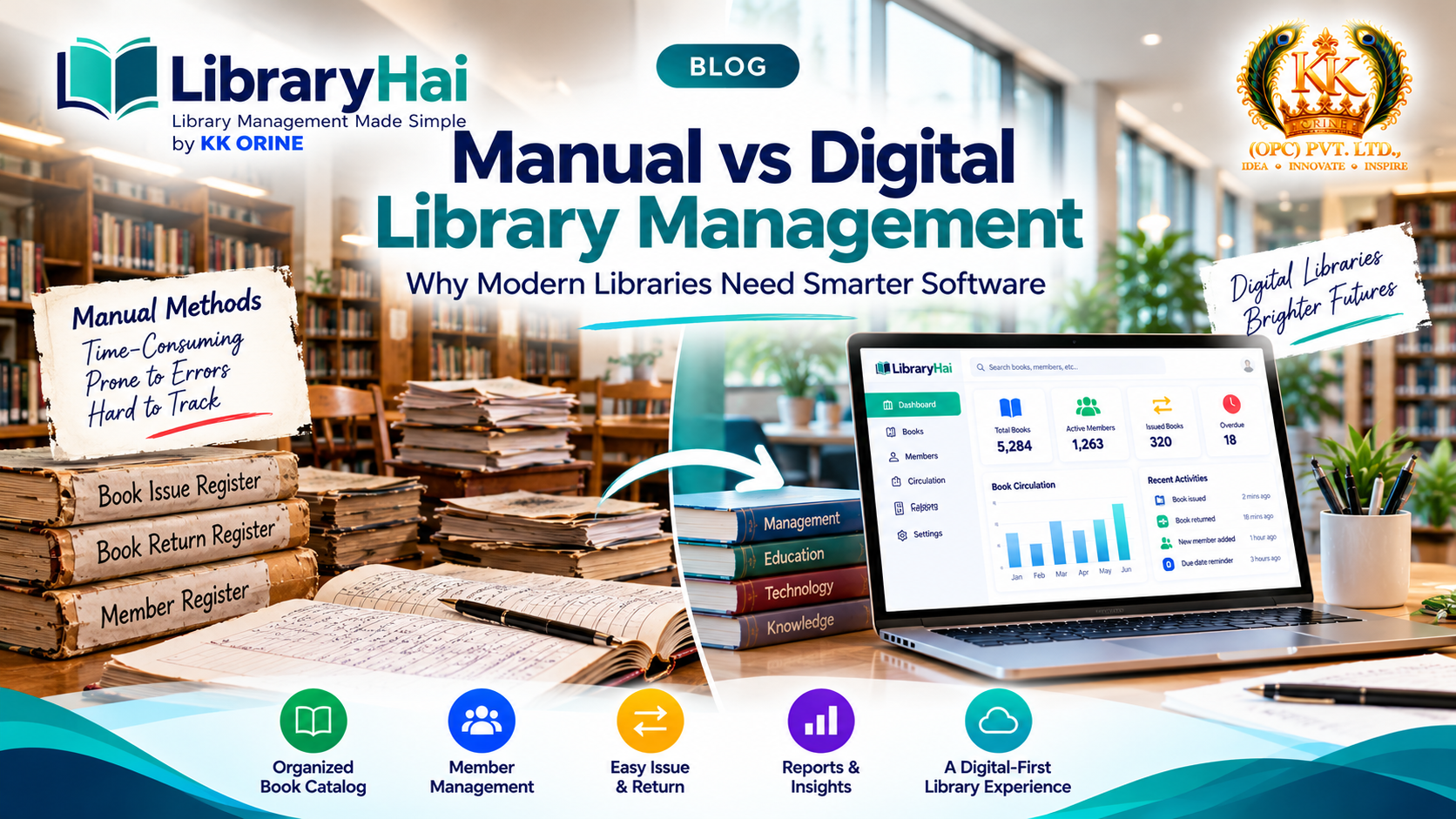
4. Manual vs Digital Library Management
Activity| Manual approach| Digital approach
Book records| Physical registers| Searchable digital catalog
Memberships| Paper forms and registers| Structured member profiles
Book issues| Handwritten entries| Recorded transactions
Returns| Manual verification| Updated circulation status
Searching| Checking registers| Searchable records
Reports| Manual compilation| System-generated reports where supported
Digital systems do not automatically eliminate every operational challenge. Successful adoption also requires accurate data, appropriate staff training, and reliable processes.
5. Benefits of Digital Library Management
Better Organization
Centralized records can make book and membership information easier to maintain.
Improved Efficiency
Structured workflows can reduce repetitive administrative activities and help staff spend more time assisting readers.
Greater Accuracy
Digital validation and consistent recordkeeping can help reduce avoidable errors.
Better Visibility
Library administrators can use available reports to understand circulation patterns and operational needs.
Easier Scalability
As the number of books and members grows, well-designed software can make increasing record volumes more manageable.
6. Introducing LibraryHai by KK ORINE
At KK ORINE (OPC) Private Limited, we believe technology should simplify everyday work.
This philosophy guides the development of LibraryHai, our upcoming library management software.
LibraryHai is being developed with the aim of helping library operators organize important activities through a user-friendly digital experience.
Our product vision focuses on:
- Simplifying book and catalog management.
- Supporting organized membership records.
- Improving book issue and return workflows.
- Making information easier to access.
- Reducing unnecessary administrative complexity.
LibraryHai is currently under development. Product features, availability, and subscription details will be announced as development progresses.
7. How to Prepare Your Library for Digitization
Before adopting any library management software, library operators should review their existing processes.
Step 1: Identify operational challenges
Understand which activities consume the most time or frequently cause errors.
Step 2: Organize existing records
Prepare accurate book, member, and transaction information.
Step 3: Define staff responsibilities
Decide who will manage catalog information, memberships, and circulation.
Step 4: Evaluate software requirements
Choose software based on actual library workflows, ease of use, data protection, and long-term needs.
Step 5: Train staff and adopt gradually
A phased transition can help teams become comfortable with new processes.
The goal should be to improve library operations, not simply replace paper registers with digital screens.
8. The Future of Library Management
As technology becomes more accessible, libraries have opportunities to improve the way they organize resources and serve readers.
Digital recordkeeping, searchable catalogs, and streamlined workflows can support more efficient operations.
However, the most effective solutions will be those designed around the real needs of librarians, administrators, and members.
At KK ORINE, this is the approach we're taking with LibraryHai.
Conclusion
Libraries are centers of knowledge, and their management systems should support that important role.
Moving from manual processes toward digital library management can help organizations improve recordkeeping, reduce repetitive work, and make information easier to access.
With LibraryHai, KK ORINE is working toward a practical and accessible solution for modern library operations.
LibraryHai — Smarter Library Management Is Coming.
Follow KK ORINE (OPC) Private Limited for upcoming product announcements, development updates, and early-access information.
KK ORINE — IDEA • INNOVATE • INSPIRE
Discussion (0)
Join the technical discussion with our engineers.
Sign In to Comment →